
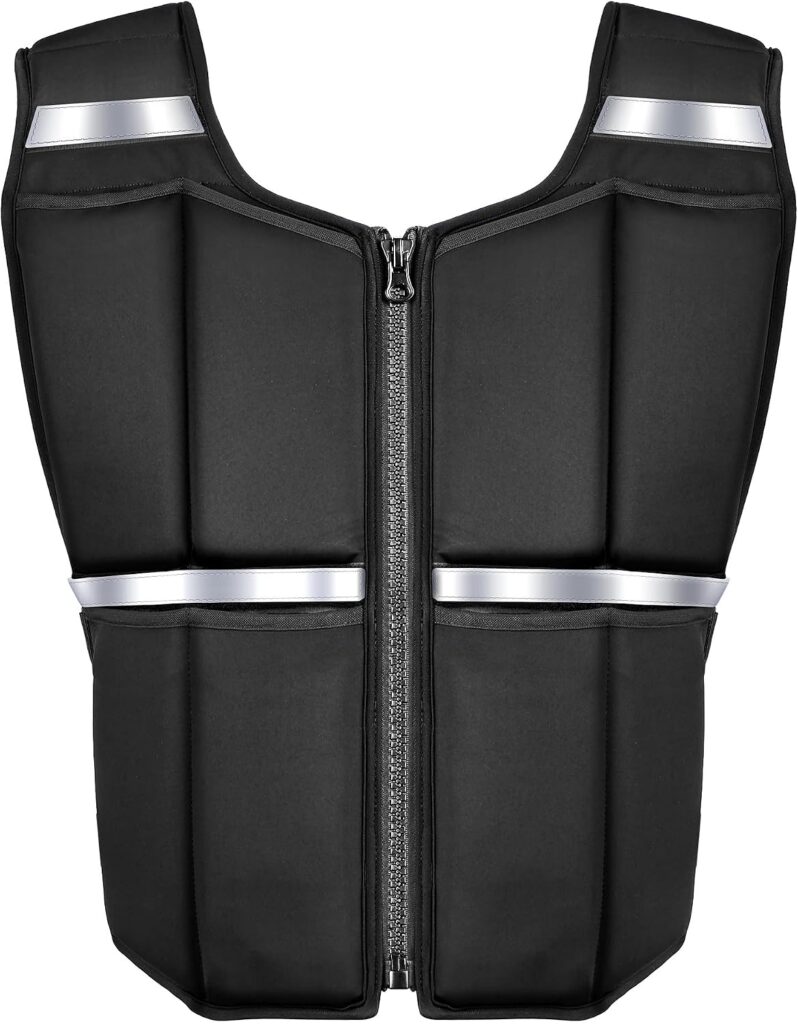
Sprinting with a weight vest sounds like the purest way to make fast running harder: same track, same session, more resistance. The direct answer is that weight vest sprints work best as a light-load tool — a few extra pounds, carried by a vest that holds them completely still, added to strides and short accelerations once your unloaded sprint form is solid. Load them like a gym effort and they stop being sprint work.
The mechanics explain both the appeal and the risk. Every extra pound moves with you through every footstrike, so force through the ankle and hip rises at the same pace and fatigue arrives sooner. One caveat up front: nothing here comes from lab testing or hands-on trials — it is mechanical reasoning applied to what the product listings state. What follows is what the load actually changes, which vest features matter at speed, how a first session should look, and the mistakes that turn a useful tool into a form problem.
What the added load does to a sprint
Sprinting is already the highest-force thing most runners do. A vest multiplies that: the added mass has to accelerate and land with you, stride after stride, so effort climbs at any given speed and your breathing rises earlier than an unloaded run of the same distance would justify.
Form is the first casualty. Ground contact stretches a little, posture drifts as the legs tire, and anything the vest does — bounce, slide, pull forward — gets amplified at speed. That is why the load itself matters less than how still it stays. A vest that shifts mid-stride changes your mechanics exactly when you can least afford it, which is why fit outranks capacity for this job.
Control those two problems and a real upside appears. The stride you already own now costs more, so controlled-pace repetitions become a strength-endurance session without changing your running style, and short hill efforts get a way to make modest speeds feel demanding again. The benefit only survives if the load stays small enough that your sprint still looks like one.
Choosing a vest you can sprint in
Disclosure: if you buy through links on this page, FitGearPilot may earn a commission at no extra cost to you.
Fit decides everything at sprint pace. The vest should cinch close to the torso, ride high enough that it does not slam against your hips, and split the weight front and back rather than hanging it at one point. Load range comes next: for this use you want a vest that starts light — single digits — rather than one whose smallest setting already feels heavy. Construction is the last filter. Silicone blocks are softer and quieter than metal fills and conform to the body instead of clanking; iron-sand fills spread evenly for the same effect. A slim, zippered profile stops the load swinging, and reflective detailing earns its place on early-morning sessions.
Three options from the records that fit sprint duty
The APEXUP Adjustable Weighted Vest, 4-10lb/12-18lb/20-32lb Vest with 6 Ironsand Weights and Large Pocket, Weight Vest for Men Women Strength Training, Running, Walking is the natural starting point because its smallest range runs from just 4 to 10 pounds. Six iron-sand weights distribute the fill evenly, a buckle closure keeps the one-piece neoprene shell locked down, and the large front mesh pocket swallows a phone and keys at the track. Reinforced stitching and reflective straps round out a vest that averages 4.6 stars across 1,127 ratings (see it on Amazon).
The 2-45lb Adjustable Weighted Vest Men w/Silicone Weights,Running Rucking Vest takes the silicone route: sixteen polymer blocks that the listing describes as soft, flexible, and rustproof, scaling the vest from a 2.2-pound base up through 20, 35, and 45-pound configurations. For sprinters the story is the fit — a slim, zippered neoprene body with 0.2 inches of foam padding at the shoulders, adjustable waist belts to kill bounce, and removable reflective strips for dark mornings. It averages 4.5 stars from 210 ratings and is machine washable (see it on Amazon).
The Adjustable Weighted Vest w/Silicone Weights Women Men Running Walking Vest applies the same silicone-block idea with balance as the pitch: eight blocks front, eight back, so the load does not drag you forward as you accelerate. It shares the 2.2-pound bare weight, front zipper, machine-washable build, 0.2-inch shoulder padding, and detachable reflective strips, topping out around 30 pounds. The trade-off is a thinner track record — 4.3 stars from just 16 ratings (see it on Amazon).
How a first session should look
Warm up exactly as you would for fast running, without the vest: easy jogging, dynamic drills, a few build-ups. The vest goes on for the main set, not the warm-up, and the set starts with strides — relaxed accelerations to roughly the pace where you can still hold form — before anything all-out. Walk-back recovery keeps each repetition honest: the vest makes them expensive, and sprinting is not the place to prove toughness against fatigue.
A simple opening set: four to six strides in the vest well below top speed, then two to four short hill efforts of 20 to 30 meters, cut off the moment your form no longer matches your unloaded running. Hills come first for a mechanical reason — the slope caps top speed and shortens the landing spike, which is exactly the part the vest makes harsher.
Progression is unglamorous: add repetitions before you add weight, add weight only when the vest feels unremarkable at stride pace, and return to the lightest setting whenever you take the vest onto genuinely fast running again. If the set you can hold with good form gets shorter rather than faster, that is the signal to reduce the load, not push through it.
Common mistakes that turn a tool into a liability
The classic error is buying heavy. A vest whose ceiling reaches 30, 40, or 45 pounds looks like better value, but those top plateaus belong to gym and rucking work; sprint sessions live at the bottom of the range, and paying for weight you will never run in is a poor trade.
Second is sprinting in a loose vest. Bounce that is mildly annoying on a walk becomes a form wrecking ball at speed, and the fix costs nothing: adjust the belts until nothing moves when you jog in place.
Third is treating every fast session as a loaded one. A vest changes the training stimulus, and ordinary sprint work plus recovery is what lets you absorb it — a loaded day, then normal speedwork, not back-to-back vest sessions. Last, keep expectations honest: the vest magnifies whatever mechanics you already bring, so judge it by how your unloaded runs feel over the following weeks, not by how one session leaves you.
Weight vest sprint decision checklist
- Load: a range that starts in single digits, not one that begins where sprints end.
- Fit: belts snug enough that nothing shifts when you jog in place.
- Distribution: weight split front and back, no front-heavy pull.
- Fill: soft, stable material — silicone or iron sand — that stays put at speed.
- Comfort: shoulder padding and a close, zippered profile for fast running.
- Visibility: reflective details if you train early or late.
- Programming: strides and hills first, top-speed work last, extra load last of all.
Weight vest sprint FAQs
How heavy should a weight vest be for sprints?
Light enough that your form does not change — for most runners that means the bottom of an adjustable range, in the single digits, until the vest feels boring at stride pace. Speed is the variable you are protecting. If the load costs you posture or turnover, it is too heavy for sprint work no matter what the scale says.
Do weight vest sprints make you faster?
They can build the strength end of speed, because every stride at a controllable pace costs more work — but no vest guarantees faster times, and none of the listings here claim otherwise. Treat loaded sprints as one input alongside normal speedwork and recovery, and measure the result in your unloaded running.
Are weight vest sprints hard on your joints?
Added weight increases the force your ankles, knees, and hips absorb on every landing, so caution is the sensible default. Keep loaded sessions short, favor hills before flat-out track work, and stop the set when form starts to fray. The vest should leave your legs tired, not your joints complaining.
Should you take the vest to the track?
Eventually, yes — but earn it. Strides on grass or up a hill come first, then flat accelerations at controlled speeds, and only then anything near top speed. Track surfaces are unforgiving under extra load, so a vest session there should stay short and finish well before your form does.
Where to go next
If sprint work has you thinking about a dedicated vest, the guide to the best weighted vest for running compares the field on load ranges, fit, and stability. The Running weighted vest guidance hub collects the rest of this cluster, from loaded easy runs to walking comparisons.

