
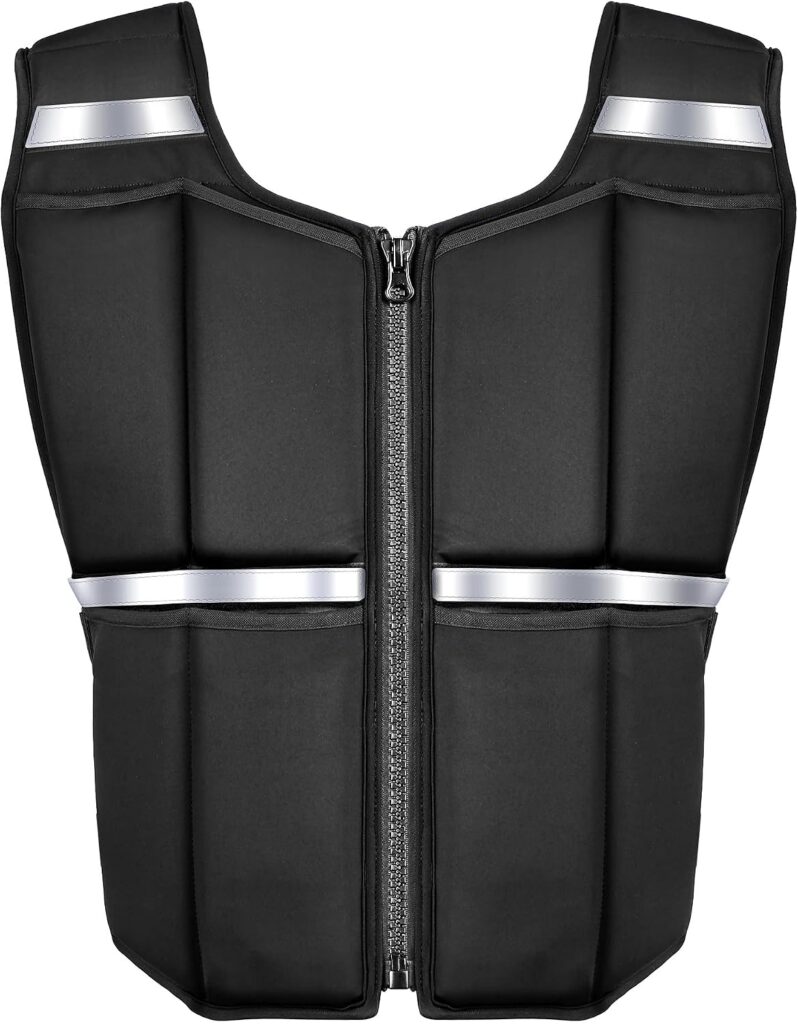
Running with a weighted vest is less about how much weight you add and more about how the vest carries it. A vest that sits high, hugs the torso, and keeps its load from shifting turns an ordinary route into noticeably more work. A vest that bounces, chafes, or drags on your shoulders turns the same run into a negotiation with your gear.
This guide covers what actually changes when you add weight to a run, the fit details that keep a vest quiet at stride pace, and the trade-offs worth weighing before you buy. Eleven vests currently marketed for running and walking appear throughout as concrete examples. One honest note up front: the comfort and bounce claims quoted below are the Amazon listings’ own, not independent measurements. What those listings do establish — weight ranges, fill types, closures, padding — is where this guide puts its weight.
Affiliate disclosure: this guide includes Amazon affiliate links. If you buy through one, FitGearPilot may earn a commission at no extra cost to you.
The direct answer
Yes, a weighted vest can be part of running — provided the load stays modest, the weight spreads evenly across your torso, and the closure holds everything still while you move. A weighted vest for running needs three things: a range that starts light, distribution that does not pile weight on one spot, and hardware that keeps the load from swinging. The vests positioned for running sit at the low end of their ranges, with settings like 4-10 lb or 2-20 lb. What separates a bounce-free run from a frustrating one is design rather than brand, and that is what the rest of this guide unpacks.
What changes when you run with weight
The shape of the load matters as much as the size
Weight spread evenly front and back feels completely different from weight concentrated in one place, because your torso has to counterbalance every stride. The PACEARTH X-shape vest takes its name from the way the design spreads load across the whole torso instead of stacking it on the shoulders (see it on Amazon). The ONETWOFIT 2-45 lb vest carries its resistance in sixteen flexible silicone blocks rather than rigid metal, which the listing says keeps the load soft against the body and immune to rust (see it on Amazon). Fill material decides how a vest contours as you move: silicone blocks flex, iron-sand fill conforms, and cast-iron blocks stay put but press harder at their contact points.

Bounce is what ruins a weighted run
A vest bounces when its load can move independently of your torso. The fix is hardware rather than luck: waist belts, chest straps, and wide closure panels pull the weight in tight. The FITVANCE silicone-block vest is explicit that its adjustable waist belts exist to eliminate bounce at running pace (see it on Amazon), and the APEXUP iron-block vest brands its padded-shoulder, belted construction a “Zero Bounce Fit” (see it on Amazon) — one is a design explanation, the other a marketing claim, and both point at the same feature set. The test costs nothing: jog in place, then run twenty easy strides. If you feel the load arrive a split second after each footstrike, the fit is not there yet.
Added demand, not added speed
Extra mass makes every stride cost more effort; that much is physics. Listings lean on outcome language — endurance, stamina, calorie burn — because outcome language sells. Treat the weight as an intensity dial you control, and judge it by how your runs feel and how you recover.
Choosing a vest you can actually run in
Weight range and increments
Adjustability decides whether a single vest can follow your progression. The APEXUP adjustable vest ships with six iron-sand weight bags across three ranges — 4-10, 12-18, and 20-32 lb — so one purchase covers a long stretch of training (see it on Amazon). The BAGAIL iron-block vest builds its settings from rust-resistant 2.5 lb blocks, reaching 20, 30, or 40 lb depending on how many the pockets take (see it on Amazon). Coarse blocks rearrange faster; fine ones let you climb in smaller steps. Fixed-weight vests sell each weight separately, which is simpler to choose and impossible to outgrow.
Closure and fit hardware
Closures decide how fast a vest goes on and how precisely it cinches. The APEXUP clip-closure vest pairs a quick-release clip system with padded shoulder straps and a waist belt, the kind of design you can adjust in seconds mid-workout (see it on Amazon). The Henkelion neoprene vest relies on a single adjustable strap to stop the load sliding, and its listing carries a warning worth repeating: the elastic belongs at the waist, so check the wear direction before your first run (see it on Amazon). Zipper fronts and wide hook-and-loop panels sit between those extremes — slower to fit, very secure once set.
Storage, visibility, and care
Storage matters more on runs than in gyms, because keys, phones, and ID all come along. For carrying, the BAGAIL Comfort-Fit vest pairs a detachable phone pouch with a large rear mesh pocket and cleans with a damp cloth only — no machine washing (see it on Amazon), while the PACEARTH Lycra vest moves storage to an arm-strap pouch with an earphone opening and adds a second chest strap for a snugger fit (see it on Amazon). Reflective strips appear on every vest referenced here, detachable on several for a cleaner daytime look. Care instructions split the field too: neoprene zipper vests are generally machine washable, sand-and-nylon builds usually are not, and that difference is worth checking before a vest becomes your several-times-a-week companion.
Three practical setups from the listings
A walk-jog build-up. Start where the range starts. The PACEARTH X-shape’s six 1 lb bags and the APEXUP adjustable’s 4-10 lb stage both let you add resistance in steps small enough that your legs, not your ego, set the schedule. Keep weighted sessions to two or three easy outings a week rather than converting every run at once.

Fixed and simple. If adjusting blocks before each run sounds like friction, a fixed vest removes it. The Poudee iron-sand vest comes in set weights from 6 to 30 lb with adjustable straps over an even, conforming fill (see it on Amazon) — the same grab-and-go logic as the fixed Henkelion and PACEARTH designs covered above. Fit and bounce rules apply to a fixed build exactly as they do to an adjustable one.
Strength-adjacent days. The heavy settings on the iron-block builds — 30-45 lb across the BAGAIL, ONETWOFIT, and APEXUP ranges — are marketed for rucking, hiking, and strength circuits, and those loads suit slow, deliberate movement far more than fast running. If you want one vest for both worlds, the range and its smallest increment matter more than the top number.
Common mistakes when running with a weighted vest
- Starting at the top of the range. A heavy vest changes a run long before it changes your fitness: pace drops, form gets sloppy, and the effort of every stride climbs. Start with the lightest setting that still feels like work.
- Buying fixed weight as a first purchase. Fixed vests are wonderfully simple, but adjustability is the safer starting point while you are still learning which load your runs want.
- Ignoring bounce until it ruins a run. Loose straps and a load that sits away from the body announce themselves within the first mile; jog in place before you leave the driveway.
- Skipping the care instructions. Machine-washable neoprene and wipe-clean nylon need different habits, and a sweat-soaked vest is the wrong place to learn the difference.
- Forgetting visibility. Reflective strips exist because weighted runs often happen before sunrise or after dark; keep them on when the light is low.
Decision checklist
- Weight range that starts light enough for running, not just strength work.
- Increments small enough to progress without big jumps.
- Even front-and-back distribution, or a design that spreads load across the torso.
- Closure hardware — belt, straps, or buckles — that pulls the weight close and holds it.
- Storage sized for what you actually carry on a run.
- A care routine you can live with, checked before purchase.
- Reflective details if any running happens in low light.
Frequently asked questions
Why run with a weighted vest instead of just running farther?
A vest changes the effort of the route you already run instead of adding distance to it. The appeal is practical: same loop, more demand, no extra time on the schedule.
What keeps a weighted vest from bouncing while running?
Tight, adjustable hardware — waist belts, chest straps, and closure panels that hold the load against your torso — plus fill that conforms instead of shifting. Every vest named above uses some combination of those, and none of them works loose on the rack.
Is a fixed-weight vest good enough for running?
If the fixed weight suits the running you do, yes: fixed vests are simpler to choose and cheaper to buy. They only become a problem when the weight no longer matches the session, because there is nothing to remove.
How heavy should a weighted vest be for running?
The runner-positioned configurations in these listings cluster between roughly 4 and 20 lb, which is why the adjustable designs start their ranges at 2 or 4 lb. Pick the smallest vest that still grows with you, and climb in the smallest increments the hardware allows.
Related commercial page: comparing specific vests
When the shortlist is set and you want models side by side, the roundup of the best weighted vest for running compares eight options by their stated specs. Every product linked above carries its full spec sheet on its own page, and the Running weighted vest guidance hub collects the site’s running coverage in one place.

