On paper, a weighted vest is the simplest upgrade you can make to CrossFit-style training: no rack, no plates, no barbell math. In practice, most people searching for a weight vest for women crossfit want answers to narrower questions — will a vest stay put through burpees and pull-ups, how much load actually makes sense, and does it need to be made specifically for women?
The short version: you do not need a women-specific vest, but you do need one that fits close, spreads its weight evenly, and adjusts tightly enough to stay quiet when you move. Those are fit and construction questions, and the label on the box answers none of them. This guide walks through how a vest changes the movements you already do, what separates a comfortable design from a bouncy one, and how to match the load style to the way you actually train, with three current vests as concrete reference points.
Quick Answer: What a Weight Vest Adds to Women’s CrossFit Training
A weight vest adds a constant, torso-carried load to movements you already do with bodyweight: air squats, push-ups, pull-ups, burpees, step-ups, lunges, runs, and marches. Since the weight rides on your body rather than in your hands, your technique stays close to the unweighted version while the demand climbs. That is exactly what makes a vest useful in CrossFit-style conditioning, where movements are mixed and repeated.
The catch is that every fitting flaw gets amplified. A vest that shifts, bounces, or restricts breathing is a nuisance during burpees and a genuine problem during hanging work. So yes — a weight vest is a practical tool for women’s CrossFit training, provided three things line up: even weight distribution, a closure that adjusts to your torso, and a load you can control through full-range, high-rep movement.
Core Concepts: How a Vest Behaves Under Load
Where the weight sits matters more than how much there is
Vests carry load in two broad ways. Soft-shell designs hold fine iron sand inside a neoprene body and spread it across the torso, while rigid designs hold shaped plates against the chest and back. For dynamic training, spread load is usually the quieter choice: no hard edge digs in during floor work, and the weight moves with you instead of lagging a beat behind.
Bounce is the failure mode to design against. A vest built for this kind of training holds its load close with a body-hugging cut, straps that tighten in small steps, and contact points that will not chafe over a long session. Anything that only feels secure while you stand still will tell on you during the first round of burpees.
Fixed-weight versus adjustable loading
Fixed-weight vests are sealed at one load, which makes choosing simple: pick a weight and you are done. Adjustable designs cover a range, either by selling the same shell at several fixed weights or by using removable weight bags you can take out in small increments. That flexibility usually costs more and can add bulk, but it lets one vest serve light, skill-focused sessions and heavier strength work alike — which matters once you think in months of progression rather than weeks.
Buckles versus zippers
The closure decides how well a vest adapts to your torso. Wide-range buckle systems fit many body shapes and stay secure under load, though their comfort depends on padding where the straps cross your chest. Zip-up vests go on and off faster; the better ones add a second lock at the waist or shoulders so the zipper is not doing all the work once you start moving.
How to Choose a Weight Vest for CrossFit Training
Affiliate disclosure: FitGearPilot may earn a commission on purchases made through the Amazon links on this page, at no extra cost to you.
Start from your own sessions rather than from spec sheets: the right vest is the one whose load range, fit, and care routine match how you actually train. The weights and features below come from the manufacturers’ current listings, so treat every specific as a snapshot. Three designs show the practical range.
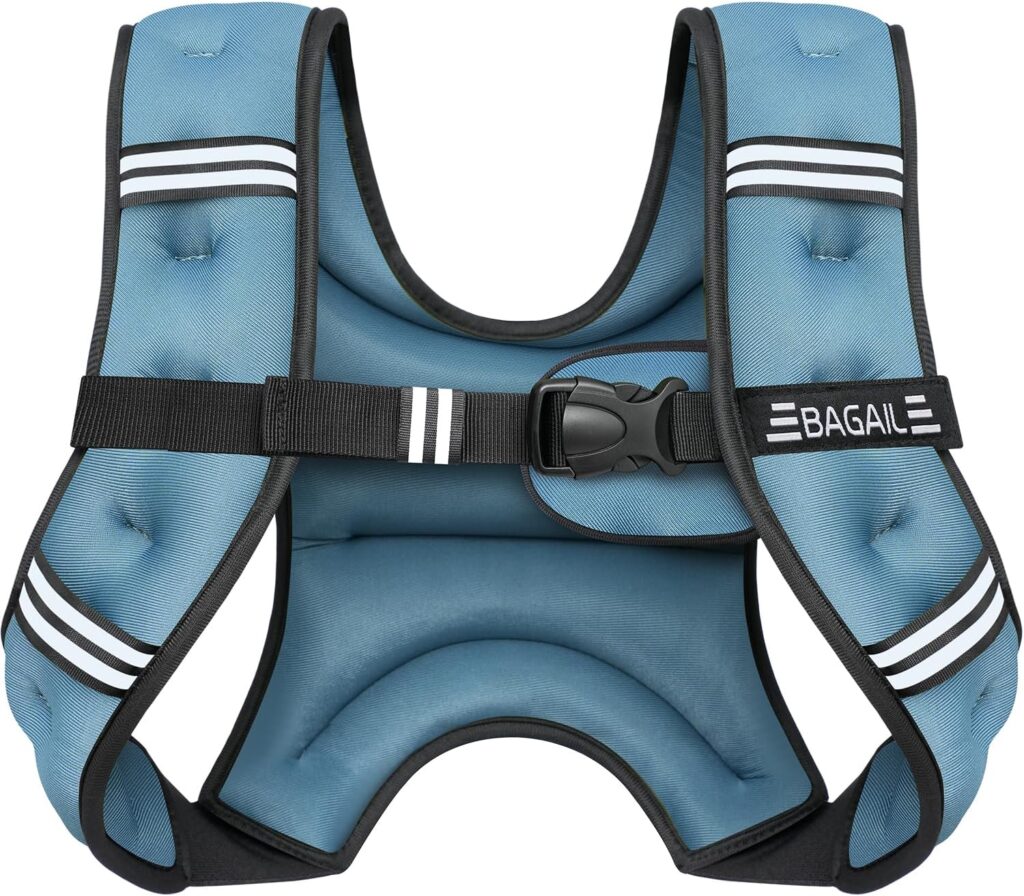
The BAGAIL Comfort-Fit weighted vest is cut and sized for women, running from 5 to 30 lb, with iron sand held in a breathable, sweat-resistant neoprene shell built for even distribution without bulk or bounce. The comfort details are what suit it to this use case: upgraded straps, smooth-stitched edges that help prevent chafing, and a body-hugging fit. There is also a detachable phone pouch that fits most phones up to 7 inches plus a large rear mesh pocket, and the shell is wipe-clean only — machine washing is off the table (see its Amazon listing).
If you would rather keep the decision simple, the Ama Divo fixed-weight vest comes in 8, 12, 16, and 20 lb versions and leans on heavy-duty adjustable buckles to fit a wide range of body shapes, including plus-size, where a zipper design can run out of adjustment. Soft padding sits under the buckles to prevent irritation, breathable neoprene and mesh handle airflow, and reinforced double-stitching keeps the iron sand where it belongs. A detachable arm bag for a phone comes with the vest, which is backed by a one-year warranty (Amazon listing).
And for progressive loading, the Sportneer 2-42 lb adjustable vest starts at 2 lb — the vest alone — and accepts up to sixteen removable 2.5-lb weight bags, eight across the chest and eight across the back. The zip-up shell adds dual locks at the waist and shoulders to hold the load steady during metcons, runs, and other dynamic work, and the shell is machine washable once every bag is removed. Its sizing is aimed at men, so check the fit and adjustment range carefully against your own frame (current Amazon listing).
Practical Examples Across a Training Week
On strength-biased days, small loads on pulling and pushing movements go a long way: weighted pull-ups, dips, and push-ups are the classic entries, and the BAGAIL listing explicitly names pull-ups, dips, burpees, and sprints among its recommended uses. Start lighter than feels impressive; the goal is keeping your unweighted technique intact for every rep.
Conditioning is the opposite case: keep the load light enough that breathing and range of motion are unaffected, whether that is burpees, step-ups, lunges, short sprints, or a metcon finisher. Adjustable designs earn their price here, because a 2.5-lb step is a manageable jump between sessions, while a fixed vest locks you into one intensity.
Endurance work is the third natural fit. Weighted marches and rucking-style walks build easy training volume, and both the Sportneer and Ama Divo listings name walking, running, and cycling among their intended uses. If the vest goes outdoors early or late in the day, reflective details stop being a nice-to-have.
Common Mistakes to Avoid
None of these are complicated, but each one shows up again and again:
- Buying your target weight instead of your starting weight. The vest you can control today is the one that builds progress; the one you grow into sits in a closet.
- Judging fit by the label. Women-specific, unisex, and men’s sizing can all work — what matters is the adjustment range and where the load actually sits on your torso.
- Ignoring the closure style. A zipper without a secondary lock can strain during dynamic work, and unpadded buckles can rub during long sessions.
- Skipping the care instructions. Some shells are wipe-clean only, while others are machine washable once the weight bags come out — guessing wrong shortens the vest’s life.
- Loading movements that lose form. If range of motion shortens or technique breaks down, the vest is too heavy for that movement, whatever the chart says.
Decision Checklist
- Load range covers both your current strength and where you expect to be in a few months.
- Weight is spread evenly, with a fit that stays close during jumping, hanging, and floor work.
- The closure tightens in small steps and stays secure without pressing on your chest or ribs.
- Contact points are padded or smooth-stitched, so long sessions will not chafe.
- The care routine matches how you actually clean your gear.
- Front-and-back reflective strips are present if you train near traffic; a phone pouch or arm bag helps if you carry one.
FAQ
Do you need a women-specific weight vest for CrossFit?
No. A vest marketed for women, like the BAGAIL comfort-fit above, is simply one route to a close fit, but unisex designs with wide buckle ranges fit many body types just as well. Fit, distribution, and adjustability decide comfort; the label decides very little.
What weight should a woman start with?
There is no universal starting weight — the right load depends on the movements you train and the control you already have. What the market does show is the practical range: women’s comfort-fit lines span 5 to 30 lb, unisex fixed models run 8 to 20 lb, and adjustable designs can start as low as 2 lb before you add weight. Pick the heaviest load that leaves your unweighted technique untouched through an entire session, then build from there.
Can you do burpees, pull-ups, and metcons in a weighted vest?
Yes — those are exactly the situations vest makers design for. The Sportneer lists metcons and dynamic workouts directly and adds waist-and-shoulder locks to keep the load close; a snug, low-bounce fit is what separates a vest you can condition in from one you will fight. Keep the load modest when a workout is gymnastics-heavy, and test bounce before the workout starts rather than mid-round.
Related Commercial Guides
When you are ready to compare specific models in depth, the site’s buying guide to the best weighted vest for crossfit breaks down the strongest options for this kind of training, and the best weighted training vest guide covers designs built for broader strength work. For everything else in this training area, the category hub gathers all of the site’s Strength Training weighted vest guidance in one place.