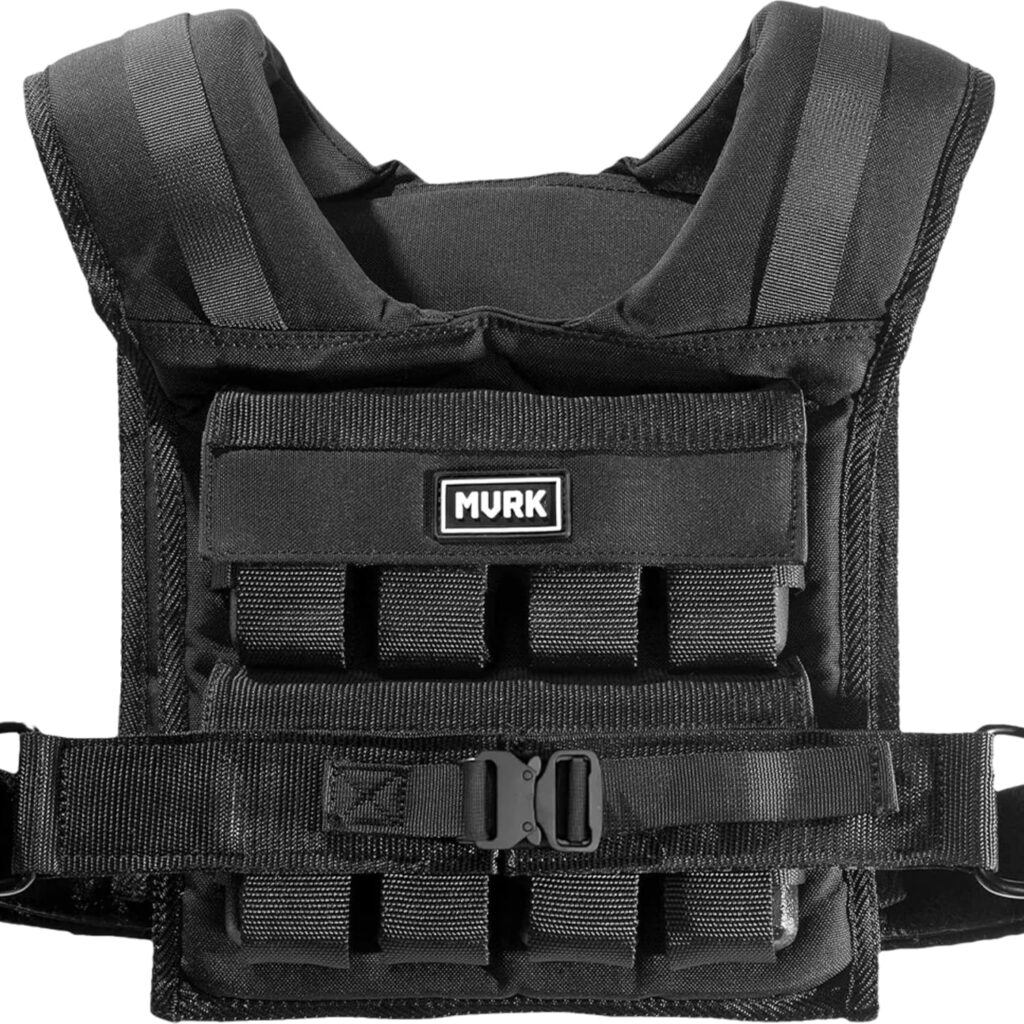
Adjustable weight vests promise one vest for every stage of training, and most popular listings really do span a wide load range. But “adjustable” means three different things on three different product pages: some vests take removable physical weights, most ask you to choose a weight from a size menu when you order, and a few only adjust the fit around a fixed load. Buy the wrong kind, and the vest that looked like a three-year training partner turns out to be a one-setting purchase.
This guide sorts nine widely bought vests by how they actually adjust, how the load sits on your body, and who each design suits. The range runs from a $12 fixed 12 lb starter to a vest that reaches 45 lb with removable iron weights, with most picks covering 6 to 30 lb. Everything below — prices, ratings, weight options, materials — comes from the product listings themselves, not gym testing, and where a listing stays silent the guide says so instead of guessing. Disclosure: if you buy through links on this page, FitGearPilot may earn a commission at no extra cost to you.
The short answer
Only two vests here offer true incremental adjustability: the 23/36/45 lb vest built around removable 2.1 lb iron weights, and the EMPOWER 4-in-1, which reconfigures between four weight settings. Every other vest adjusts by picking a weight step when you order — the load on your back never changes after that. Within that group, Zeerun lists the most weight options between 6 and 30 lb, including in-between sizes most brands skip, while Poudee, Zikopomi, and PACEARTH cover a comparable range with different comfort hardware. The Henkelion, TONE Fitness, and ProsourceFit are fixed-load vests with adjustable fit — sensible buys if you already know the weight you want, but not weight-adjustable in the strict sense.
How these picks were sorted
Four criteria separated these vests. Adjustability type comes first: whether the load itself changes (removable weights, reconfigurable packets) or only the fit (straps, buckles, elastic sides). Next is fit hardware, because chest straps, shoulder pads, and closure styles decide how a vest sits on a broad or heavy-set torso — a recurring concern in how men search for these vests. Fill and construction matter too, since iron pellets, iron sand, and solid iron plates move differently under a runner’s stride. The last filter is wearability over months of use: padding, breathable fabric, pocket placement, and visibility on dark roads.
The comparison table
Prices and ratings are the listed values captured for this guide, not live offers.
| Vest | Weight range | Adjustment type | Fit hardware | Price | Rating |
|---|---|---|---|---|---|
| PACEARTH | 6–30 lb (8 sizes) | Weight step at purchase | Two chest straps, shoulder pads | $18.99 | 4.7 (4,947) |
| Zeerun | 6–30 lb (9 sizes) | Weight step at purchase | Shoulder pads, elastic band + buckle | $19.99 | 4.5 (4,389) |
| Poudee | 6–30 lb (8 sizes) | Weight step at purchase | Adjustable straps, hook-and-loop | $19.99 | 4.6 (2,622) |
| Zikopomi | 6–30 lb (7 sizes) | Weight step at purchase | Two elasticated straps | $19.99 | 4.6 (2,170) |
| TONE Fitness | 8 or 12 lb | Weight step at purchase | Buckle + elastic sides | $20.99 | 4.5 (4,412) |
| Henkelion | Fixed 12 lb | Fit only | Stability strap, mesh pocket | $12.23 | 4.5 (9,091) |
| ProsourceFit | Fixed 20 lb | Fit only | Top and bottom buckles | $29.29 | 4.6 (1,901) |
| EMPOWER | 4–10 lb or 10–16 lb | Removable packets | Padded straps, waist straps | $29.95 | 4.5 (2,628) |
| Weighted Vest Men 23/36/45 | 23 / 36 / 45 lb | Removable 2.1 lb weights | Extra-wide shoulders, modular pockets | $109.99 | Not listed |
The picks, use case by use case
Zeerun: the most weight steps between 6 and 30 lb
The Zeerun Weighted Vest, 6/8/10/12/15/18/20/24/30LB for Men Women (check the Zeerun price on Amazon) earns its spot through granularity: the size menu runs 6, 8, 10, 12, 15, 18, 20, 24, and 30 lb, so you can climb in smaller jumps than most rivals offer. The listed construction — skin-friendly neoprene with internal sealing that keeps iron particles in, double-stitched reinforced seams, thickened shoulder pads, and an elastic band with adjustable buckle — addresses the two usual cheap-vest complaints: leaking filler and shoulder chafe. It is also the best-ranked vest in this comparison, #4 in its Amazon category.
Poudee and Zikopomi: iron-sand daily trainers
Both of these cover 6 to 30 lb at $19.99, and both fill the weight evenly with iron sand. The Poudee Weighted Vest, 6lb/8lb/10lb/12lb/16lb/20lb/25lb/30lb Weight Vest for Men Women, Body Weight Vests Adjustable with Reflective Stripe for Strength Training, Running, Workout, Jogging, Walking (Poudee on Amazon) closes with hook-and-loop straps and leans on double stitching for durability; it is the higher-ranked of the pair (#3 in category). The Zikopomi Weighted Vest Woman Man, 6lb/8lb/12lb/16lb/20lb/25lb/30lb Weight Vest with Reflective Stripes for Workout, Strength Training, Running, Fitness, Muscle Building, Weight Loss, Rucking Vest (current Zikopomi price) uses two elasticated straps with buckles and adds reflective strips front and back for night sessions. One honest footnote from Zikopomi’s own listing: a new vest may carry a slight smell and should air out for a day or two.

PACEARTH: comfort hardware for long sessions
The PACEARTH Weighted Vest,6lb/8lb/10lb/12lb/16lb/20lb/25lb/30lb Weight Vest with Reflective Stripe, Body Weight Vests for Women, Men, Weight Loss Workout, Strength Training, Running, Walking, Jogging (PACEARTH on Amazon) has the highest rating here — 4.7 across 4,947 ratings — and the reason shows in its spec list: a second generation with added shoulder pads, two adjustable chest straps that the maker says fit a variety of body shapes, and a phone pouch with an earphone opening. Its odor-free Lycra fabric is the maker’s answer to heat — described as breathable and skin-friendly — which matters if your vest time happens in summer rather than an air-conditioned gym.
Henkelion: the cheapest way to start
At $12.23, the Henkelion Weighted Vest Weight Vest for Men Women Kids Weights Included, Body Weight Vests Adjustable for Running, Training Workout, Jogging, Walking (Henkelion on Amazon) is the budget floor of this comparison, backed by the largest review base: 4.5 stars from 9,091 ratings. The fill is iron pellets and metal rock rather than river sand, in a neoprene shell with a mesh back pocket. One caution belongs here: the listing markets the vest as adjustable, but its own features state the weight is not adjustable. The strap steadies the fit; it does not change the load.
TONE Fitness: the simple gym option
The TONE Fitness Weighted Vest for Men & Women – Workout Vest for Walking, Running, Cardio & Strength Training | 8 lb or 12 lb Options | Multiple Colors (TONE Fitness vest on Amazon) keeps things deliberately plain. It is a 100% neoprene vest with buckle closure, elastic sides, reflective strips, and a zippered pouch, in 8 lb or 12 lb versions and several colors. Nothing here pushes the category forward, but for a gym-bag vest that adds resistance to walks and calisthenics, the 4.5 across 4,412 ratings suggests it does the unglamorous job reliably.
ProsourceFit: fixed 20 lb with the widest fit adjustment
The ProsourceFit Exercise Weighted Training Vest (ProsourceFit’s Amazon listing) carries a single 20 lb load, with top and bottom buckles that the maker says adjust to fit most heights and body types — the most generous fit range of any fixed-weight vest here. Weights sit balanced within the neoprene shell to prevent shifting. Taller or broader men who already know 20 lb is their working load get a better shot at a proper fit than the one-size elastic designs offer.

EMPOWER: the lightest adjustable start, with a fit trade-off
The EMPOWER Weighted Vest for Women with Reflective Strips – Fixed 8lbs, Adjustable 4-10lbs (4 in1) or Adjustable10-16lbs (4 in 1), Strengthen Muscles, Boost Bone Health, and Burn More Calories for Workout – Rucking Vest (EMPOWER’s Amazon listing) is, besides the 45 lb option, the only vest here whose weight changes on the vest itself: a 4-in-1 design that reconfigures between 4 and 10 lb (or 10 and 16 lb in the larger version). This is explicitly a women’s vest: an X-shaped contour with an enhanced bust fit and waist straps sized 24 to 48 inches. A smaller-framed man who wants a light, reconfigurable starting load may like the weight range, but the cut was drawn for a different body — a real fitting risk to weigh against the 4 lb floor.
The 23/36/45 lb vest: serious load, true adjustability
The Weighted Vest Men, 23lbs/36lbs/45lbs Adjustable Weight Vest (check its current Amazon price) sits apart from the rest in every column. Solid 2.1 lb iron weights — ten, sixteen, or twenty of them depending on vest size — slot into modular pockets, so the load climbs in small increments all the way to 45 lb. The 1.2-inch foam padding, extra-wide shoulders, and 900D fabric target heavier training, with D-rings and patch panels for customization. It costs $109.99, several times the budget picks, and unlike every other vest here, no customer rating is listed for it — a gap worth knowing about before spending three figures.

Who each pick suits
- You want the load to grow with you: Zeerun’s fine step menu for under $20, or the removable-weight 23/36/45 lb vest if you train above 30 lb.
- You already know your weight: the Henkelion at 12 lb or ProsourceFit at 20 lb cost less than climbing through steps you will never buy.
- You walk or run long in heat: PACEARTH, for the comfort hardware described above.
- You need a big-frame fit: the 23/36/45 lb vest’s extra-wide shoulders and ProsourceFit’s dual-buckle range are the two vests here that explicitly address larger bodies.
- You want a small, reconfigurable load: EMPOWER starts at 4 lb — with the fit trade-off described above.
Limitations and trade-offs
The biggest trade-off is structural: once you choose a weight step, it is permanent. Outgrow a 12 lb step and the upgrade path is another vest; only the removable-weight designs avoid that, at a higher price. The second cost arrives at checkout: every design that solves the permanence problem — removable packets, wide step menus — asks more money than the fixed-load vests that simply do one job.
Buyer’s guide: choosing between these designs
Match the adjustment type to your timeline
If the plan is progressing from 6 lb to 30 lb over months of walking and bodyweight work, a wide step menu gets you there one purchase at a time, and the in-between sizes on Zeerun make each step smaller. If you want one vest that reconfigures for years, removable weights are the honest answer, and the 23/36/45 lb vest is the only design here built for that above 30 lb.
Fit for your frame
Two-chest-strap designs like PACEARTH and dual-buckle designs like ProsourceFit explicitly target a range of body shapes and heights. Elastic-sided vests (TONE Fitness) stretch with the torso, while hook-and-loop closures (Poudee) and elasticated straps (Zikopomi) fine-tune snugness around a fixed frame. Broad-shouldered buyers should also look at shoulder hardware: padded or extra-wide straps appear on Zeerun, PACEARTH, and the 23/36/45 lb vest.
Fabric, fill, and visibility
Neoprene dominates this category, and PACEARTH’s Lycra shell is the one exception to it. Fill types split between iron sand or pellets (most picks here) and solid iron plates (the 23/36/45 lb vest, whose listing stresses zero shifting during runs). Reflective strips show up on nearly every vest — treat them as standard for dawn and dusk road work rather than a differentiator.
FAQ
What does “adjustable” actually mean on a weight vest listing?
Three different things: removable weights (the 23/36/45 lb vest, EMPOWER’s 4-in-1), a menu of weight steps you choose at purchase (most vests here), or adjustable fit around a fixed load (Henkelion, ProsourceFit). Check which one the listing means before buying — the price differences only make sense once you know.
What weight should a man start with?
The makers behind these vests converge on the same guidance: start lighter than feels necessary and add load gradually. The right number depends on your activity, body, and base fitness, and none of these vests prescribes one — treat any specific starting-load advice that ignores both as a guess.
Are fixed-weight vests a bad buy?
No. For a known single purpose — a 12 lb walking vest, a 20 lb strength vest — they cost less and skip setup entirely. They only become a trap when bought by someone who expects to change the load later.
Related supporting guides
For the broader field beyond adjustable designs, the site’s best weighted vest for men guide covers the wider picks, and the Men weighted vest guidance hub collects every men’s article in one place.