What a plate loaded vest is
A plate loaded vest is a weighted vest that takes its mass from weights you add and remove — weight plates, or in some designs small cast-iron blocks — instead of from fill sewn permanently into the garment. Strip away the straps and pockets and what remains is a carrying system built around choice: you decide how much weight goes in, and you can change it later. Shoppers will see the same idea sold under several names, including loadable weight vest and weight loading vest.
A fixed-weight vest, by contrast, arrives at one weight and stays there. One loadable purchase can cover a brisk walk at a light load today and a heavier strength session months from now. The price of that flexibility is a little homework: before buying, you need to know what the vest actually accepts — plate sizes, block counts, capacity ceilings — because those details vary from design to design.
The three loading formats you will see
Nearly everything in this category falls into one of three formats. Identify the format and most buying questions answer themselves.
| Format | How the load works | What to check before buying |
|---|---|---|
| Block-loading vest | Small removable weights (often cast-iron blocks) slide into pockets across the vest; add or remove blocks to step the total up or down. | Block increment, how many blocks ship with the vest, maximum configured weight. |
| Plate-pocket vest | Front and back pockets accept standard weight plates within a stated size and capacity limit. | Accepted plate dimensions, maximum load rating, whether plates are included. |
| Dedicated plate carrier | A carrier built around one manufacturer’s plates or a specific plate format, holding the weight in a fixed position on the body. | Which plates the carrier is designed for, and whether they are sold separately. |
In practice the formats differ in three ways: how finely you can adjust the load, where the weight sits on your body, and what else you have to buy. Block systems step up in small increments. Plate-pocket systems take whatever matches their pocket dimensions. A dedicated carrier is deliberately simple — one carry position, tuned for one activity.
How to choose a loadable design
Start with compatibility, not capacity
The first question is not “how heavy does it go” but “what exactly does it take”. A tactical-style vest will specify pockets sized for plates up to a stated footprint, plus the most those pockets can bear. A rucking carrier may be built around one proprietary plate format and accept nothing else. Already own plates? Measure them against the listed pocket size. Starting fresh? Check what actually ships in the box — several carriers expect you to buy plates separately.
Match the load position to the movement
Where the weight sits shapes how the vest feels as much as how heavy it is. A traditional weighted vest spreads the load across the front and back of the torso and hugs the body through walks, squats, and push-ups. A rucking-style carrier concentrates the weight high on your back, where it stays stable and leaves the chest unobstructed — welcome during full-range push-ups, and cooler, though a different feel on the move. Neither position wins outright; it depends on what you do while wearing it.
Check the fit range and the release
Loadable designs still have to fit snugly — loose straps let the load shift mid-movement. Read the stated waist range and size span instead of trusting a single “size” label, and check whether the shoulder straps adjust as well as the belt. If you expect to shed the vest between sets, a quick-release closure is worth hunting for. Material matters too: breathable contact surfaces for long sessions, and a shell fabric suited to where you train — some shells are water-resistant, and some carriers rinse clean with a hose.
Three loadable setups that show the range
Three current examples show how differently the same idea can be built. Each is described strictly from its own listing.
Block-based adjustability: APEXUP adjustable weight vest
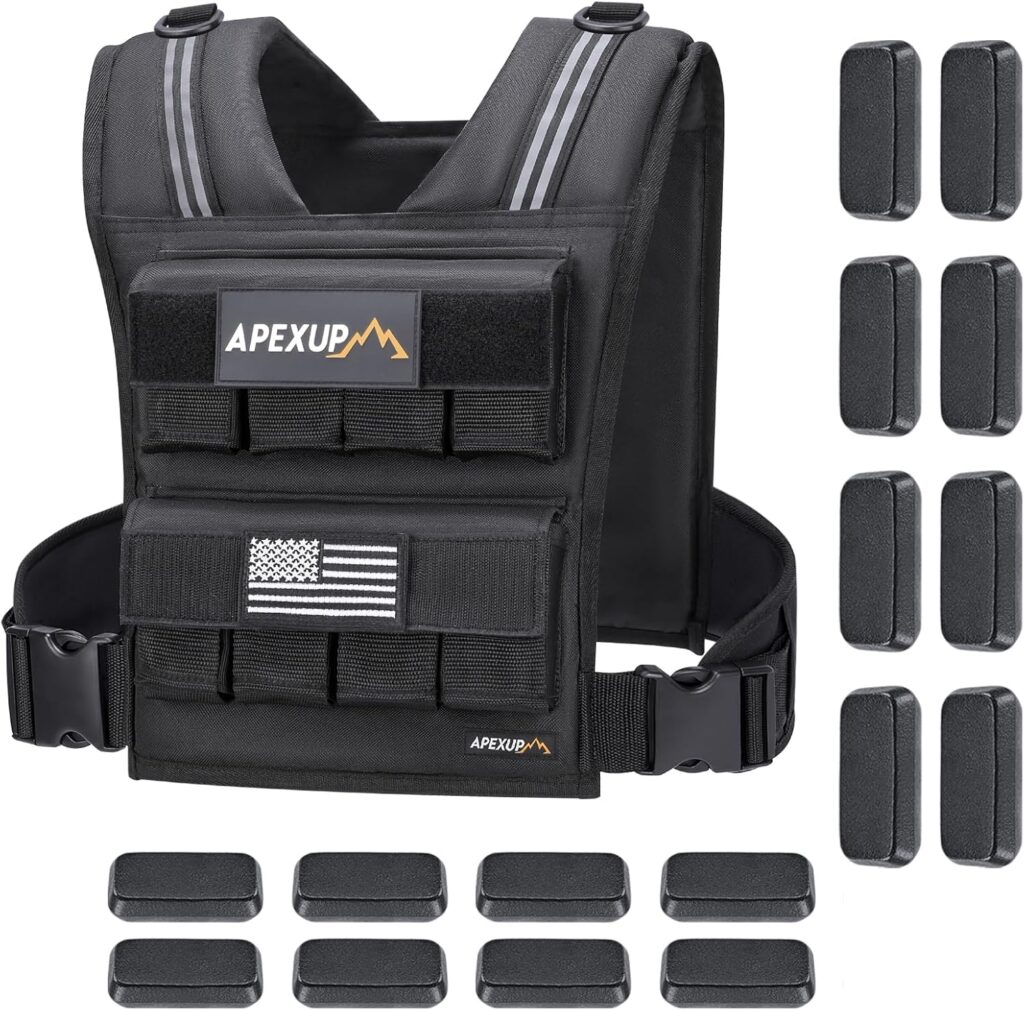
The Weighted Vest Men, Adjustable Weight Vest for Running from APEXUP is the clearest example of the block format. Configurations run from 20 to 40 pounds, built from removable 2.5-pound cast-iron blocks, so the load climbs in small steps as training progresses — no need to buy a heavier vest later. Around the blocks, the listing describes 1000D nylon with reinforced stitching, padded shoulder straps with an adjustable waist belt, breathable construction, and reflective strips for low-light walks and runs. If fine-grained adjustability in a conventional vest shape is the priority, this is the format to shortlist.
Plate pockets with a high ceiling: Miramrax tactical vest
The Tactical Weighted Vest for Men and Women Strength Training Running Workout from Miramrax takes the plate-pocket route. Front and back pockets accept plates up to a 10-by-12-inch footprint, with a stated capacity of up to 50 pounds — enough ceiling to grow into without replacing the vest. Per the listing, the fit adjusts across roughly 32 to 52 inches at the waist, a quick-release system gets the vest off fast, the plate pockets are mesh-padded, and MOLLE webbing with patch panels accepts pouches or identifiers. The shell is described as tough and water-resistant. It is the format to weigh first if you want standard plates, a wide fit range, and modular attachments in one package.
Dedicated carrier for rucking: GORUCK Ruck Plate Carrier 3.0
The GORUCK Ruck Plate Carrier 3.0, Weighted Rucking Backpack shows what purpose-built looks like. It is made specifically for GORUCK’s 10, 20, and 30 pound Standard Ruck Plates, which are sold separately — budget for them if you go this route. Weight rides high and stable on the back, the position rucking is built around, and the listing leans on comfort details: CORDURA lining on the back panel and strap undersides so it can be worn against skin without chafing, EVA foam lumbar support, dual-density shoulder straps, and YKK zippers. Wrapping only the back rather than the chest, it leaves the chest free for full-range movement, and a hose is all the cleaning it needs. GORUCK’s SCARS lifetime guarantee covers the construction.
Common mistakes when buying a loadable vest
- Assuming any plate will fit. Pocket dimensions are specific — one tactical vest above takes plates up to 10 by 12 inches, and a dedicated carrier may accept only its own maker’s plates. Measure first.
- Forgetting the plates are extra. Some products ship with their weights included; others, like the GORUCK carrier, expect you to buy plates separately. Check the box contents before comparing prices.
- Ignoring the fit range. A vest that cannot cinch down to your torso will let the load shift. The Miramrax listing states its adjustable span explicitly, and that number matters more than the size letter.
- Buying capacity you will not use. A 50-pound ceiling is meaningless if you never load past 25. Match the ceiling to a realistic progression, and prefer small load increments if you expect to grow gradually.
- Treating one load as right for every activity. The APEXUP listing itself maps lighter loads to walks, mid loads to squats and pull-ups, and the full load to push-ups and intervals. Loading to the maximum for every movement defeats the point of an adjustable vest.
A short decision checklist
- Which loading format suits you: removable blocks, standard plates in pockets, or a dedicated carrier?
- Does the product state exactly what it accepts — plate size, block count, plate format — and do you have or plan to buy those weights?
- What is the realistic maximum load, and how finely can you adjust below it?
- Where does the weight sit — front and back, or high on the back only — and does that match your main activity?
- Does the size range cover your waist and shoulders, and can you tighten it enough to stop the load shifting?
- Do you need a quick-release closure, water-resistant shell, or hose-clean design for how you train?
Questions buyers ask
Do plates come included with a plate loaded vest?
It depends on the product. Some configurations, like the APEXUP vest above, ship with their cast-iron blocks included in the stated weight options. Dedicated carriers often exclude plates — GORUCK’s listing states plainly that its Ruck Plates are sold separately. For anything else, read the listing’s “what’s included” details rather than assuming.
How much weight can a loadable vest take?
The ceiling is set by the system. The examples in this guide range from a 40-pound block configuration, to plate pockets rated for up to 50 pounds, to a carrier designed around plates from 10 to 30 pounds. Treat the stated capacity as the limit and the increment size as the practical tuning range.
Will a standard barbell plate work in one?
Only if the pocket is sized for it. Plate-pocket vests state the plate dimensions they accept — the 10-by-12-inch specification on the Miramrax vest is a typical example. Standard barbell plates vary in diameter and thickness by weight, so compare your plates against the stated pocket footprint rather than assuming “plate” means “any plate”.
Is a plate carrier better than a weighted vest?
Neither is better in general; they distribute the same idea differently. A conventional vest spreads the load across the front and back of the torso and stays close to the body, which suits walking, calisthenics, and gym work. A plate carrier concentrates the weight on the back and leaves the chest open, which suits rucking and full-range floor movements. Choose by activity, not by category.
Where to go from this guide
If one of these three setups fits what you need, each has a product page on this site with the full specification. To compare current offers, the APEXUP vest is listed on Amazon, the Miramrax tactical vest is listed on Amazon, and the GORUCK carrier is listed on Amazon — because prices and included accessories change, those pages, not this guide, are the current source of truth. If you are still weighing a loadable design against a conventional one, the Blog weighted vest guidance hub collects the rest of our guides on choosing and using weighted vests.
Disclosure: if you buy through links on this page, FitGearPilot may earn a commission at no additional cost to you. This does not influence what this guide covers or recommends.